Monday, June 4, 2018

Microsoft has acquired GitHub for $7.5B in stock

After a week of rumors, Microsoft today confirmed that it has acquired GitHub, the popular Git-based code sharing and collaboration service. The price of the acquisition was $7.5 billion in Microsoft stock. GitHub raised $350 million and we know that the company was valued at about $2 billion in 2015.

Former Xamarin CEO Nat Friedman (and now Microsoft corporate vice president) will become GitHub’s CEO. GitHub funder and former CEO Chris Wanstrath will become a Microsoft technical fellow and work on strategic software initiatives. Wanstrath had retaken his CEO role after his co-founder Tom Preston-Werner resigned following a harassment investigation in 2014.

GitHub says that as of March 2018, there were 28 million developers in its community, and 85 million code repositories, making it the largest host of source code globally and a cornerstone of how many in the tech world build software.

But despite its popularity with enterprise users, individual developers and open source projects, GitHub has never turned a profit and chances are that the company decided that an acquisition was preferable over trying to IPO.

GitHub’s main revenue source today is paid accounts, which allows for private repositories and a number of other features that enterprises need, with pricing ranging from $7 per user per month to $21/user/month. Those building public and open source projects can use it for free.

While numerous large enterprises use GitHub as their code sharing service of choice, it also faces quite a bit of competition in this space thanks to products like GitLab and Atlassian’s Bitbucket, as well as a wide range of other enterprise-centric code hosting tools.

Microsoft is acquiring GitHub because it’s a perfect fit for its own ambitions to be the go-to platform for every developer, and every developer need, no matter the platform.

Microsoft has long embraced the Git protocol and is using it in its current Visual Studio Team Services product, which itself used to compete with GitHub’s enterprise service. Knowing GitHub’s position with developers, Microsoft has also leaned on the service quite a bit itself, too and some in the company already claim it is the biggest contributor to GitHub today.

Yet while Microsoft’s stance toward open source has changed over the last few years, many open source developers will keep a very close look at what the company will do with GitHub after the acquisition. That’s because there is a lot of distrust of Microsoft in this cohort, which is understandable given Microsoft’s history.

In fact, TechCrunch received a tip on Friday, which noted not only that the deal had already closed, but that open source software maintainers were already eyeing up alternatives and looking potentially to abandon GitHub in the wake of the deal. Some developers (not just those working in open source) were not wasting time even to wait for a confirmation of the deal before migrating.

While GitHub is home to more than just open source software, if such a migration came to pass, it would be a very bad look both for GitHub and Microsoft. And, it would a particularly ironic turn, given the very origins of Git: the versioning control system was created by Linus Torvalds in 2005 when he was working on development of the Linux kernel, in part as a response to a previous system, BitKeeper, changing its terms away from being free to use.

The new Microsoft under CEO Satya Nadella strikes us as a very different company from the Microsoft of ten years ago — especially given that the new Microsoft has embraced open source — but it’s hard to forget its earlier history of trying to suppress Linux.

“Microsoft is a developer-first company, and by joining forces with GitHub we strengthen our commitment to developer freedom, openness and innovation,” said Nadella in today’s announcement. “We recognize the community responsibility we take on with this agreement and will do our best work to empower every developer to build, innovate and solve the world’s most pressing challenges.”

Yet at the same time, it’s worth remembering that Microsoft is now a member of the Linux Foundation and regularly backs a number of open source projects. And Windows now has the Linux subsystem while VS Code, the company’s free code editing tool is open source and available on GitHub, as are .NET Core and numerous other Microsoft-led projects.

And many in the company were defending Microsoft’s commitment to GitHub and its principles, even before the deal was announced.

Still, you can’t help but wonder how Microsoft might leverage GitHub within its wider business strategy, which could see the company build stronger bridges between GitHub and Azure, its clod hosting service, and its wide array of software and collaboration products. Microsoft is no stranger to ingesting huge companies. One of them, LinkedIn, might be another area where Microsoft might explore synergies, specifically around areas like recruitment and online tutorials and education.


Rookout releases serveless debugging tool for AWS Lambda

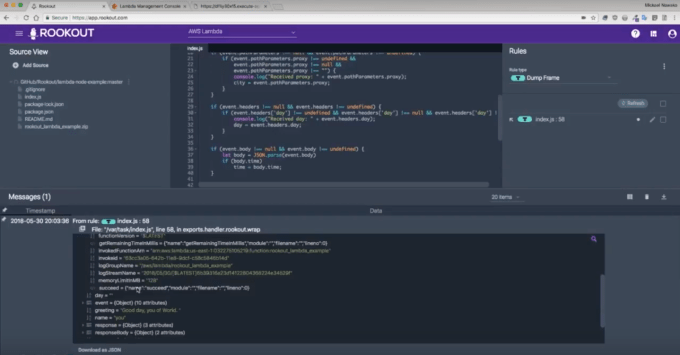
The beauty of serverless computing services like AWS Lambda is that they abstract away the server itself. That enables developers to create applications without worrying about the underlying infrastructure, but it also creates a set of new problems. Without a static server, how do you debug a program that’s running? It’s a challenge that Israeli startup Rookout has solved in its latest release.

The company has achieved this by providing a way to mark the serverless code with “breakpoints.” Rookout can then collect developer-defined information about the serverless code, allowing them to track issues even while the application is live running in a serverless environment.

This ability to run a trace, which is common in traditional applications, is much more difficult in a serverless one because there is no permanent underlying machine on which the application is running, says Rookout CEO Or Weis.

Rookout running serverless debugger. The information at the bottom of the screen gives developers insight to debug code running on AWS Lambda. Photo: Rookout

“Specifically with serverless, it is extremely hard to predict how your software will behave in that new environment [because] it’s extremely hard to know where software is running and [it has been] almost impossible to see how it’s behaving in production,” Weiss explained.
.
He said the only way to solve that to this point has been writing more code in the form of log lines and SDK calls, which creates a whole administrative layer that Rookout wanted to eliminate from the process. By providing an interface to see what’s happening inside the code, the company is giving developers a way to debug live code running in a serverless environment in the same fashion they have debugged more traditional applications.

They can share this information with a myriad of popular adjacent tools including application performance management (APM) like New Relic, log management like Splunk or alerting like PagerDuty. They can also use it to simply go back in and fix the code issue if that’s what’s required.

While serverless computing isn’t truly serverless, there isn’t a dedicated server running the application. Instead, the vendor provides the required amount of server resources based on a particular event trigger. When that event happens, the code runs and the customer gets charged. This is in stark contrast to traditional development where you allocated a server to run the application and you pay for it, regardless of whether you use it or not.

__

Rookout Lambda debugging demo:


PlayVS, bringing esports infrastructure to high schools, picks up $15 million

PlayVS, the startup building esports infrastructure at the high school level, has today announced the close of a $15 million Series A funding round. The financing was led by New Enterprise Associates, with participation from existing investor Science, as well as CrossCut Ventures, Coatue Management, Cross Culture Ventures, the San Francisco 49ers, Nas, Dollar Shave Club founder Michael Dubin, Twitch cofounder Kevin Lin, and others.

PlayVS first publicly launched out of the LA-based Science startup studio in April. The company partnered with the NFHS, the equivalent of the NCAA for high school-level sports, to build out leagues, rules and more around high school esports.

Most high school sports are governed by the NFHS, which writes the rules, hires referees, schedules seasons and determines the format of playoffs and state championships. That same infrastructure might carry over from one high school sport to another, but esports represents a new challenge for the NFHS.

PlayVS brings to market a platform that schedules games, helps schools hold tryouts and form teams, and pulls in stats real-time from games thanks to partnerships with game publishers.

In October, PlayVS will launch its inaugural season, bringing organized esports to more than 18 states and approximately 5 million students across 5,000 high schools.

As esports continue to grow, colleges and professional organizations have already started investing in scholarship programs and pro teams respectively. But whereas other high-level teams look at high school athletes for recruiting, the same infrastructure has not yet been put into place for esports.

PlayVS wants to change that. The new round of funding will go towards expanding the product and the team to eventually put PlayVS in every high school across the country. The company has yet to announce which schools will participate and which games will be available during the first season, but PlayVS has confirmed that the games will be PC-based and will come from the Multiplayer Online Battle Arena, Fighting and Sports genres.


How Yelp (mostly) shut down its own data centers and moved to AWS

Back in 2013, Yelp was a 9-year old company built on a set of internal systems. It was coming to the realization that running its own data centers might not be the most efficient way to run a business that was continuing to scale rapidly. At the same time, the company understood that the tech world had changed dramatically from 2004 when it launched and it needed to transform the underlying technology to a more modern approach.

That’s a lot to take on in one bite, but it wasn’t something that happened willy-nilly or overnight says Jason Yellen, SVP of engineering at Yelp. The vast majority of the company’s data was being processed in a massive Python repository that was getting bigger all the time. The conversation about shifting to a microservices architecture began in 2012.

The company was also running the massive Yelp application inside its own datacenters, and as it grew it was increasingly becoming limited by long lead times required to procure and get new hardware online. It saw this was an unsustainable situation over the long-term and began a process of transforming from running a huge monolithic application on-premises to one built on microservices running in the cloud. It was a quite a journey.

The data center conundrum

Yellen described the classic scenario of a company that could benefit from a shift to the cloud. Yelp had a small operations team dedicated to setting up new machines. When engineering anticipated a new resource requirement, they had to give the operations team sufficient lead time to order new servers and get them up and running, certainly not the most efficient way to deal with a resource problem, and one that would have been easily solved by the cloud.

“We kept running into a bottleneck, I was running a chunk of the search team [at the time] and I had to project capacity out to 6-9 months. Then it would take a few months to order machines and another few months to set them up,” Yellen explained. He emphasized that the team charged with getting these machines going was working hard, but there were too few people and too many demands and something had to give.

“We were on this cusp. We could have scaled up that team dramatically and gotten [better] at building data centers and buying servers and doing that really fast, but we were hearing a lot of AWS and the advantages there,” Yellen explained.

To the cloud!

They looked at the cloud market landscape in 2013 and AWS was the clear leader technologically. That meant moving some part of their operations to EC2. Unfortunately, that exposed a new problem: how to manage this new infrastructure in the cloud. This was before the notion of cloud-native computing even existed. There was no Kubernetes. Sure, Google was operating in a cloud-native fashion in-house, but it was not really an option for most companies without a huge team of engineers.

Yelp needed to explore new ways of managing operations in a hybrid cloud environment where some of the applications and data lived in the cloud and some lived in their data center. It was not an easy problem to solve in 2013 and Yelp had to be creative to make it work.

That meant remaining with one foot in the public cloud and the other in a private data center. One tool that helped ease the transition was AWS Direct Connect, which was released the prior year and enabled Yelp to directly connect from their data center to the cloud.

Laying the groundwork

About this time, as they were figuring out how AWS works, another revolutionary technological change was occurring when Docker emerged and began mainstreaming the notion of containerization. “That’s another thing that’s been revolutionary. We could suddenly decouple the context of the running program from the machine it’s running on. Docker gives you this container, and is much lighter weight than virtualization and running full operating systems on a machine,” Yellen explained.

Another thing that was happening was the emergence of the open source data center operating system called Mesos, which offered a way to treat the data center as a single pool of resources. They could apply this notion to wherever the data and applications lived. Mesos also offered a container orchestration tool called Marathon in the days before Kubernetes emerged as a popular way of dealing with this same issue.

“We liked Mesos as a resource allocation framework. It abstracted away the fleet of machines. Mesos abstracts many machines and controls programs across them. Marathon holds guarantees about what containers are running where. We could stitch it all together into this clear opinionated interface,” he said.

Pulling it all together

While all this was happening, Yelp began exploring how to move to the cloud and use a Platform as a Service approach to the software layer. The problem was at the time they started, there wasn’t really any viable way to do this. In the buy versus build decision making that goes on in large transformations like this one, they felt they had little choice but to build that platform layer themselves.

In late 2013 they began to pull together the idea of building this platform on top of Mesos and Docker, giving it the name PaaSTA, an internal joke that stood for Platform as a Service, Totally Awesome. It became simply known as Pasta.

Photo: David Silverman/Getty Images

The project had the ambitious goal of making their infrastructure work as a single fabric, in a cloud-native fashion before most anyone outside of Google was using that term. Pasta developed slowly with the first developer piece coming online in August 2014 and the first  production service later that year in December. The company actually open sourced the technology the following year.

“Pasta gave us the interface between the applications and development teams. Operations had to make sure Pasta is up and running, while Development was responsible for implementing containers that implemented the interface,” Yellen said.

Moving to deeper into the public cloud

While Yelp was busy building these internal systems, AWS wasn’t sitting still. It was also improving its offerings with new instance types, new functionality and better APIs and tooling. Yellen reports this helped immensely as Yelp began a more complete move to the cloud.

He says there were a couple of tipping points as they moved more and more of the application to AWS — including eventually, the master database. This all happened in more recent years as they understood better how to use Pasta to control the processes wherever they lived. What’s more, he said that adoption of other AWS services was now possible due to tighter integration between the in-house data centers and AWS.

Photo: erhui1979/Getty Images

The first tipping point came around 2016 as all new services were configured for the cloud. He said they began to get much better at managing applications and infrastructure in AWS and their thinking shifted from how to migrate to AWS to how to operate and manage it.

Perhaps the biggest step in this years-long transformation came last summer when Yelp moved its master database from its own data center to AWS. “This was the last thing we needed to move over. Otherwise it’s clean up. As of 2018, we are serving zero production traffic through physical data centers,” he said. While they still have two data centers, they are getting to the point, they have the minimum hardware required to run the network backbone.

Yellen said they went from two weeks to a month to get a service up and running before this was all in place to just a couple of minutes. He says any loss of control by moving to the cloud has been easily offset by the convenience of using cloud infrastructure. “We get to focus on the things where we add value,” he said — and that’s the goal of every company.


Music startup Roli adds Sony as investor, eyes up expanded range of hardware and software

When people think of music startups in the tech world, the focus is often on streaming, or figuring out how to better track and monetise those streams, or perhaps hardware to make those streams sound better.  But today comes news of funding for a startup that is tackling a different kind of challenge: tapping innovations from the tech world to develop new instruments and ways of creating music.

Roli, a London-based startup that develops new styles of keyboards to compose and play music that subsequently can be consumed and engaged with using smartphones and other devices, has announced new strategic investment from the Sony Innovation Fund, the VC arm of the Japanese consumer electronics and entertainment giant. The plan is to use the funds to expand its range of connected instruments — or, as the tech world might call it, hardware — as well as to develop the software that runs on them.

“We’re developing new music-making tools across hardware and software,” founder and CEO Roland Lamb said. “It’s part of our long-term plan to create the first totally integrated hardware-software platform for music creation. The funding from SIF accelerates this, and positions us to continue focusing on innovative research and development as we scale.”

This is a strategic investment for Sony across a number of areas. Among two of the biggest: Sony has a sizeable business in audio hardware; and, by way of Sony Music, one of the world’s biggest recording label conglomerates. (It’s also the owner of a vast gaming empire and film and television studios, giving it a number of entry points to working with Roli.)

Neither Roli nor Sony are disclosing the amount of funding, but for some context, PitchBook notes that Roli had previously raised around $46 million, and today the company said that the total raised is “over $50 million.” Sony is not the first strategic investor in the company: others from the music world include Universal Music; Pharrell Williams, who is also Roli’s chief creative officer; and Onkyo, the Japanese audio company that also controls the Pioneer brand of home entertainment devices — which had invested previously but is only getting disclosed today.

Technology backers, meanwhile, include a strong list of VCs such as Index Ventures, Foundry Group, Balderton, Horizons Ventures, Founders Fund, Kreos, BGF and Local Globe, Saul Klein’s new fund.

The fact that there are so many tech investors in the company is notable. It underscores how Roli is aiming to build not just a music company, but one that is rooted in tech and views a large part of the effort here as one of hardware and building software that is able to recreate on digital platforms something that has in its traditional way remained an analogue undertaking. It also speaks to how investors are looking for what new frontiers tech might be tackling, beyond those where it is already alive and well.

Roli is not disclosing its valuation with this investment, but from what we understand, Sony’s funding will have a “neutral” impact. PitchBook’s records note that the most recent round before this (in January 2017) put the company’s valuation at around $82 million.

To date, Roli has released two primary devices: the Seaboard, which resembles a traditional keyboard; and the modular ROLI BLOCKS, square-shaped pads that use light to indicate sounds, pitches and volumes. Both are characterised by their touch-sensitive squidgy material covering, which isn’t hit (as you would a normal piano or keyboard) as much as it is pressed, smudged and tapped in order to create and bend different sounds.

These work in conjunction with each other, as well as an array of other accessories and variations, with prices for the main building blocks starting at $200 and reaching up to the $3,000 range depending on what combination of devices and accessories you get.

The idea is that by changing the interface a musician or composer has with the device that producer uses to create the sounds, you are opening up a new world of music that couldn’t have been made before, or could have been made but with more work and expense involved.

One big question for me with Roli has always been the mainstream potential of its products. There has long been a gulf between creating music yourself and consuming it, with the latter being much easier to do than the former. But now that we have lightweight devices that link up with your smartphone, and make music-making something that is not the exclusive terrain of those who have put in many hours of practice time, or those who have the space to accommodate instruments, will this actually lead to more people wanting and using those devices?

The company has never released any numbers that indicate how well they sell, but they are sold in 30 markets and the plan will now be to expand that number. Of note, Roli has a deal with Apple to sell its devices in Apple’s retail stores, which speaks to how the company pitches its products and, presumably, some of the success it has had with sales.

The Sony investment being announced today is another indicator of Roli’s traction. Sony has a long legacy in audio equipment and audio technology, and one result of this partnership could be closer integration between Roli devices and, for example, Sony’s line of speakers and audio services to help the latter with its sales, in particular to a new wave of consumers who might not be as swayed by Sony’s storied history and brand as older users might be.

“A Sony Walkman was one of the first music products I ever owned,” Lamb said. “I took it on my first trip to Japan as a teenager. It was a magical way to bring my musical world with me everywhere that I went.”

Lamb himself is not a technologist by training but an avid amateur musician who studied philosophy and product design, and believes that there is a parallel between the innovations Sony helped usher in and what Roli is trying to do. “What ROLI is doing with BLOCKS is very similar to what Sony did with the Walkman, but in our case we’ve made a music creation device that you can take with you anywhere. It’s pioneering a new, liberating way of making music, just like Sony pioneered the modern revolution of music listening which hundreds of millions of people benefit from today.”


Amazon latest to face UK complaint over ‘bogus self-employment’

Amazon is the latest tech giant to be targeted by a legal challenge in the UK related to gig economy working practices.

The UK’s GMB Union is filing suit on behalf of couriers for three delivery companies used by Amazon — accusing the suppliers of making bogus claims that the delivery drivers were self employed, and thus denying them employment rights such as the national minimum wage and holiday pay.

The three Amazon suppliers in question are: Prospect Commercials Limited, Box Group Limited and Lloyd Link Logistics Limited.

The GMB Union says one of the drivers involved in the case recounted his experience of leaving the house at 6am, not returning from work until 11pm — and still having £1 per undelivered parcel deducted from his wages.

On more than one occasion the driver was also told he would not be paid if he did not complete a route — and it said he had sometimes driven when “half asleep at the wheel” in order to ensure he got paid.

Two of the three claimants in the lawsuit are also claiming whistleblower status, saying they were dismissed after they raised concerns about working practices. Among their claims are that —

  • the number of parcels allocated to drivers resulted in excessive hours and/or driving unsafely to meet targets;
  • drivers were expected to wait a significant time to load their vans, extending their working hours;
  • drivers were driving whilst tired, which posed a threat to their safety and other road users; and
  • drivers were being underpaid and not being paid amounts that they were contractually entitled to

The GMB Union says these whistleblowing claims are also being brought directly against Amazon on the basis that it was the company who determined the way the drivers should work.

In a statement, Tim Roache, GMB general secretary, told us: “Amazon is a global company that makes billions. It’s absolutely galling that they refuse to afford the people who make that money for them even the most basic rights, pay and respect. The day to day reality for many of our members who deliver packages for Amazon, is unrealistic targets, slogging their guts out only to have deductions made from their pay when those targets aren’t met and being told they’re self-employed without the freedom that affords.

“Companies like Amazon and their delivery companies can’t have it both ways — they can’t decide they want all of the benefits of having an employee, but refuse to give those employees the pay and rights they’re entitled to. Guaranteed hours, holiday pay, sick pay, pension contributions are not privileges companies can dish out when they fancy. They are the legal right of all UK workers, and that’s what we’re asking the courts to rule on.”

Amazon UK declined to answer any specific questions but a spokesperson sent us this statement:

Our delivery providers are contractually obligated to ensure drivers they engage receive the National Living Wage and are expected to pay a minimum of £12 per hour, follow all applicable laws and driving regulations and drive safely. Allegations to the contrary do not represent the great work done by around 100 small businesses generating thousands of work opportunities for delivery drivers across the UK.

Amazon is proud to offer a wide variety of work opportunities across Britain—full-time or part-time employment, or be your own boss. Last year we created 5,000 new permanent jobs on top of thousands of opportunities for people to work independently with the choice and flexibility of being their own boss—either through Amazon Logistics, Amazon Flex, or Amazon Marketplace.

The legal challenge is just the latest in the UK related to gig economy employment classifications. The most high profile to date involves Uber — which in October 2016 lost an employment tribunal which had challenged the self-employed status of a group of Uber drivers, with judges deeming them to be workers.

Uber has also since lost an appeal against the ruling but is continuing to appeal. Yet at the same time the company has announced personal injury and illness insurance products for drivers and riders in region — in what looks very much like an effort to shrink its legal liabilities as gig economy conditions come under increased legal and political scrutiny in Europe.

Complaints related to gig economy working conditions — and including delivery companies specifically — have been facing parliamentary scrutiny in the UK for many months now.

In parallel, the UK government has been reviewing employment law, including to take account of technology-driven changes to work and working patterns. And in February it announced a package of labor market reforms intended to “build an economy that works for everyone” — with the government making itself accountable for what it dubbed “good quality work” not just the quantity of jobs that are available.

The reforms were billed as expanding workers rights — with the government claiming that “millions” of workers would get new day-one rights, as well as having their rights bolstered by tougher enforcement for sick and holiday pay.

Although it also announced four consultations to help feed the reforms. So their full and final shape isn’t clear yet. And court decisions flowing from gig economy legal challenges are likely to be influential in shaping the future employment law.

Amazon has faced other concerns related to its working practices in the UK. Earlier this month the FT reported on a separate GMB Union investigation related to working practices inside Amazon’s UK warehouses — which have been the focus of long-standing concerns over pay and working conditions.

The union filed Freedom of Information requests with ambulance services near the warehouses and said it found that ambulances had been called to the centers 600 times in the last three years. According to its investigation there were 115 call-outs to just one Amazon center, in Rugeley, near Birmingham, which employs more than 1,800 people. Whereas it said it found just eight ambulance calls over the same period from a nearby Tesco warehouse — where 1,300 people work.

However Amazon told the newspaper that most of the call-outs were associated with “personal health events”, rather than being work related, adding: “It is simply not correct to suggest that we have unsafe working conditions based on this data or on unsubstantiated anecdotes.”


ING backs FinCompare, the German comparison platform for SME financing

FinCompare, the German fintech startup that offers a comparison platform for SME financing, has closed €10 million in Series A funding. The round is led by ING Ventures, the venture capital arm of dutch bank ING. The company’s previous backers Speedinvest, and UNIQA Ventures also followed on.

The comparison site currently only operates in Germany and since entering the market in February 2017 says it has attracted more than 2,500 customers and has processed more than one billion Euros. The new capital will be used by FinCompare to invest in its IT platform, including expanding the team, and for further European expansion.

The FinCompare platform itself follows a pretty traditional price comparison model, letting small to medium-sized businesses find, compare and even close a variety of financing options such as credit, leasing, factoring and finetrading. The products on offer are from more than 200 banks, alternative financial service providers, and development banks online.

The comparison platform claims to be independent, even if — like most comparison sites — FinCompare receives a kick back for any brokered loan or other financing solution in the form of commission from its financing partners. The fintech is also keen to talk up its independence in light of backing from ING Ventures, noting that remaining neutral in terms of the products it pushes is essential for any comparison platform.

ING’s investment in FinCompare is being positioned as part of the bank’s wider digitalization strategy: “ING Ventures was founded with the aim to invest in fintechs who establish a unique customer experience. Further, the investment in FinCompare enables us to expand our presence in the SME-segment in Germany,” says Benoit Legrand, CEO of ING Ventures.

Legrand also says the German SME industry is among the most attractive in Europe. “Here we can set incentives together with FinCompare and make life easier for businesses. This investment helps ING in the implementation of the bank’s strategy to become the market-leading platform for financing needs,” he adds.

Meanwhile, I understand FinCompare’s planned European expansion will see it eye up the german speaking markets of Austria and Switzerland during the next few months. Netherlands and Poland are also on the list, along with the U.K. “We are planning to launch in the U.K. in 2019, perhaps even through an acquisition,” FinCompare founder and CEO Stephan Heller tells me. Competitors in the U.K. include Fundingoptions, and Capitalise.


Labels